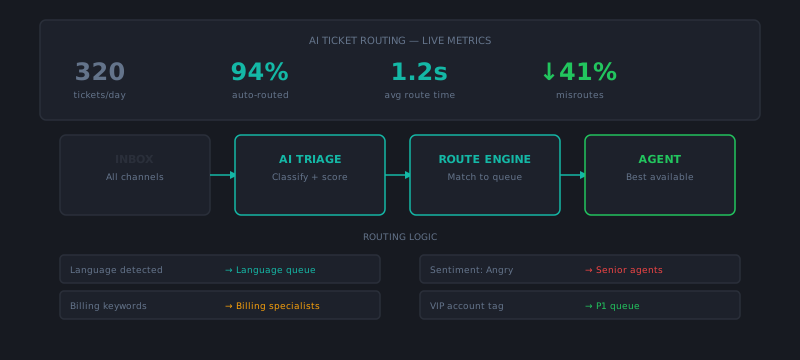
Automated ticket routing has been around for years — keyword rules, customer tier assignments, channel-based splits. What’s changed is that AI-assisted routing can now classify tickets by intent and content rather than just keywords, which means it can handle the ambiguity that makes manual routing expensive and keyword routing fragile.
But “AI routing” covers a wide range of implementation quality, from genuinely useful classification to systems that confidently misroute tickets at scale. Here’s what effective AI routing actually looks like and how to get there.
What AI routing does that rules-based routing can’t
Classic routing rules work on explicit signals: if the subject contains “billing,” route to billing. If the customer tier is enterprise, assign SLA priority 1. These rules are fast to configure and easy to audit, but they break when customer language doesn’t match your expected keywords.
A customer who writes “I keep getting charged twice every month” is clearly a billing ticket. A customer who writes “my account feels broken” might be a billing ticket or a technical ticket or a CSAT problem — the keyword “billing” never appeared. A rules engine routes the second ticket wrong. An AI classifier trained on your ticket history routes it correctly.
AI routing excels at:
- Intent classification: Understanding what the customer wants, not just what words they used
- Severity detection: Identifying urgency signals (“our entire team is locked out,” “we have a board presentation in 2 hours”) that don’t match specific keywords
- Multi-label classification: A ticket can be both “technical” and “billing” — AI can capture that complexity; keyword rules generally can’t
- Language normalization: Routing correctly regardless of whether the customer writes in formal English, casual language, or with significant spelling errors
What you need before deploying AI routing
AI routing is trained on your historical data. That means the quality of your routing is bounded by the quality of your historical ticket classification. Before deploying AI routing, audit your existing ticket tags and categories:
- Are tags applied consistently? If “billing” and “Billing” and “billing-question” are all used, your training data is noisy.
- Are there enough examples in each category? AI classifiers need a minimum training set per category — typically 200–500 examples minimum. Categories with fewer examples will have poor accuracy.
- Are your categories actually meaningful? If you have a “general” or “other” category that catches 30% of your tickets, AI routing will predict “general” frequently and won’t be useful.
Spend time cleaning your taxonomy before training. This is the work that most teams skip and then blame on the AI when accuracy is poor.
Deployment: start narrow, expand carefully
The most common mistake in AI routing deployment is turning it on for everything at once. When the classifier misroutes a P1 ticket to the wrong queue and the customer is waiting while the right agent is idle, the whole program loses credibility.
Phase 1 — Classification assist only: AI predicts the category and displays it to the agent or supervisor, but doesn’t automatically route. Humans confirm or correct. This generates accuracy data without the risk of automated misrouting.
Phase 2 — Auto-routing on high-confidence predictions only: Configure a confidence threshold (typically 85–90%) above which the AI routes automatically. Below the threshold, the ticket goes to a triage queue for human review. You’ll auto-route 60–70% of tickets with high accuracy and manually handle the ambiguous ones.
Phase 3 — Expand the confidence threshold gradually: As you see accuracy data for each category, adjust thresholds based on real performance. Some categories may reach 95%+ accuracy quickly; others may plateau at 75% and should stay in the manual review pool.
This phased approach also gives you comparison data: route quality before AI vs. after, SLA compliance by routing method, misroute rate trends.
Measuring routing quality
Don’t measure AI routing by accuracy alone. Accuracy tells you what percentage of tickets were classified correctly — but it doesn’t tell you whether the misrouted tickets were consequential.
Track these alongside accuracy:
Misroute rate by severity: A 5% misroute rate on P4 tickets costs almost nothing. A 5% misroute rate on P1 tickets is operationally damaging. Weight your measurement by ticket importance.
Time-in-wrong-queue: When a ticket is misrouted, how long before it’s corrected? This is the actual cost of misrouting. If your team catches and reroutes misrouted tickets within 5 minutes, the operational impact is low. If misrouted tickets sit for hours, the misroute rate matters a lot more.
Agent correction rate: How often do agents override AI-assigned categories? High override rates on a specific category indicate the classifier needs retraining on that category. It’s also a feedback mechanism: agents’ corrections become training data for the next model version.
SLA compliance by routing method: Your ultimate question. Does AI-routed traffic have better or worse SLA compliance than manually routed traffic? After phase 2 is fully deployed, you should see improvement.
Common failure modes
Training on too-small categories: A classifier trained on 50 examples of “API errors” will have poor accuracy on that category. Merge small categories or exclude them from AI routing until you have sufficient data.
Routing to skill-based queues before checking staffing: AI routes a ticket to the “enterprise billing specialist” queue. That specialist is out sick. The ticket sits. AI routing needs to integrate with staffing availability or have fallback queues.
Over-trusting confidence scores: Confidence scores from AI classifiers can be miscalibrated. A classifier can output “95% confidence: billing” and be wrong. Validate confidence score calibration empirically — do tickets at 90% confidence actually achieve 90% accuracy? They should, but they often don’t without calibration tuning.
The realistic improvement range
Teams with well-prepared training data, phased deployment, and reasonable ticket taxonomies typically see:
- 15–25% reduction in time-to-first-assignment (tickets reach the right agent faster)
- 10–20% improvement in first-contact resolution rate (correct routing means agents with the right expertise handle it)
- 5–10% improvement in SLA compliance on P2/P3 tickets
The improvement on P1 is often smaller because those tickets tend to already have manual triage attention. The improvement on P3/P4 is larger because those tickets are the most likely to be routed by default rules rather than careful human judgment.
AI-assisted routing is infrastructure, not magic. It makes the mechanics of ticket distribution better — quietly, at scale, without drama when it’s working correctly. The drama happens when you skip the setup work.
If you’re evaluating AI support platforms, AItocha CX includes routing intelligence as part of its resolution layer — worth reviewing to see how AI classification fits upstream of your helpdesk routing rather than inside it.