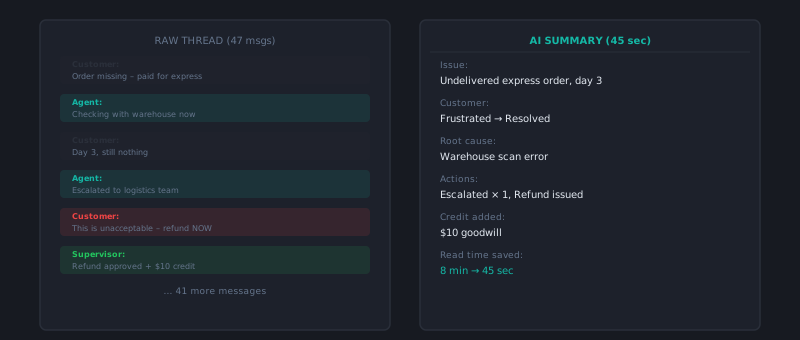
A long customer support thread is one of the most time-consuming things an agent encounters. A 40-message conversation spanning three weeks, involving two escalations, one product bug, and a billing question that got embedded mid-thread — reading and synthesizing that before you can take the next action takes 10–20 minutes. For a team handling dozens of these per day, across multiple agents who may pick up the same thread after a handoff, the time cost is significant.
AI thread summarization is one of the more practically useful applications of LLMs in support tooling. It’s not glamorous, but it quietly saves substantial time when implemented well.
What AI thread summarization does
Modern LLM-based summarization applied to a support thread can extract:
- The core issue(s): What was the original problem, and if the thread evolved, what the current open issue is
- What’s been tried: Steps taken by the customer, workarounds attempted, troubleshooting performed
- Resolution status: Has anything been resolved, partially resolved, or is everything still open?
- Key facts: Account context mentioned in the thread, relevant dates, error messages, product areas involved
- Customer emotional state: High-level indication of frustration level — useful context for the agent picking up the thread
- Outstanding questions: Questions the customer asked that haven’t been answered yet
A good summary replaces the need to read the full thread to understand the current state. The agent reads a 5-sentence summary and knows exactly where things stand.
Where it saves the most time
Handoffs: When a ticket passes from one agent to another — shift change, escalation, absence coverage — the receiving agent needs context quickly. Without a summary, they read the full thread. With a good summary, they read 5 sentences, confirm they understand the situation, and respond. For long threads, this is a 10–15 minute time savings per handoff.
Escalation context: When a ticket escalates from Tier 1 to Tier 2 or engineering, the AI summary can be included automatically in the escalation note. The receiving team gets immediate context without the escalating agent needing to manually write a summary — they verify it’s accurate and submit.
Team lead oversight: When a team lead monitors open tickets or reviews escalations, thread summaries let them quickly assess 20 tickets in the time it would previously take to assess 5. They can identify which situations need attention without deep-reading every thread.
Customer reconnection: When a customer reopens a ticket after weeks of inactivity, an AI summary helps the agent quickly re-establish context: “Based on your previous conversation about X, it sounds like the issue may have recurred — is that right?” This feels more attentive than asking the customer to re-explain from scratch.
What it misses and how to compensate
AI summaries are useful but not infallible. Common failure modes:
Subtle nuance in customer emotion: An AI summary may note that a customer was frustrated without capturing that they’re at the breaking point and at serious churn risk. The emotional read is coarser than a human read of the actual messages.
Accuracy in long or complex threads: Very long threads with topic shifts can produce summaries that capture some issues but miss others. A billing question embedded in the middle of a technical thread may be omitted if the AI over-weights the technical content.
Action items vs. context: Summaries are better at capturing what happened than what needs to happen next. The action — “waiting for customer to confirm the workaround” or “engineering reviewing the specific error” — may be in the summary, but the agent needs to verify it’s current, not historical.
Compensate by treating the summary as a starting point, not a replacement for judgment. Train agents to verify the summary against the most recent few messages in the thread, and to escalate the summary if they notice an inaccuracy before handing off.
Implementation considerations
Thread summarization can be implemented as:
- A native feature in your helpdesk platform: Zendesk, Intercom, and Freshdesk all offer AI summarization features in their higher-tier plans. These are the easiest to deploy but give you the least control over summary quality and format.
- An integration with an LLM API: Build a summarization step using OpenAI or Anthropic APIs triggered when a ticket is assigned, reaches a certain message count, or is flagged for handoff. More control over format and prompt, more engineering effort to build and maintain.
- A workflow automation trigger: Use your helpdesk’s workflow automation to call an external AI function when specific conditions are met (ticket age > 7 days, message count > 10, escalation tag applied).
Whichever approach you use, configure the summary format deliberately. A good prompt asks the model to output:
- One-sentence description of the core issue
- Current resolution status
- Key context (2–3 bullet points)
- Outstanding items (if any)
This structured output is more useful than a paragraph of unformatted prose.
Measuring whether it’s working
Track time-to-first-action on tickets that had an AI summary generated vs. those that didn’t. If the summary is reducing the time agents spend getting up to speed, first-action time should be lower on summarized tickets.
Also track summary accuracy with a quick quality flag: after receiving a summarized handoff, agents can click “summary was accurate” or “summary missed something important” in 2 seconds. These flags help you tune the summarization prompt over time and identify thread characteristics (very long threads, multi-topic threads) that generate less accurate summaries.
AI thread summarization is one of those tooling investments that’s easy to underestimate because the time savings are invisible — each individual instance doesn’t feel like a breakthrough. But at the scale of hundreds of handoffs and escalations per week, the accumulated time savings compound into meaningful capacity that agents can redirect toward the complex problems that deserve their full attention. Platforms like AItocha CX build this kind of context-preservation into the core of their resolution workflow — worth examining as a reference for how summarization and handoff should work together.