Why most playbooks fail
Support playbooks fail because they’re written by people who know the answer, for people who need to find it quickly, in a format that assumes you have time to read. An agent handling a live chat doesn’t have time to search a 40-page document.
The format that works
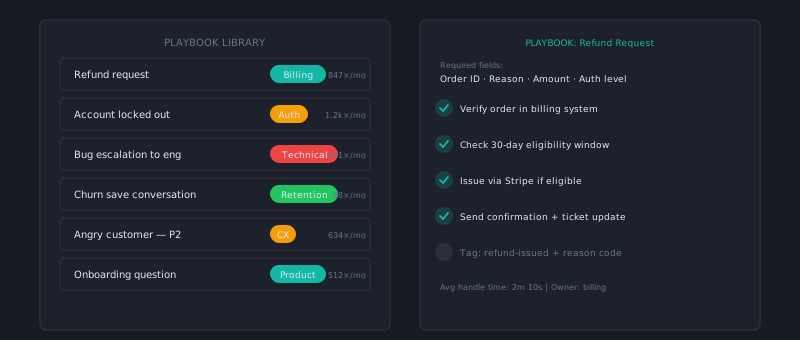
Each playbook covers one scenario. Not “billing issues” — that’s a category. “Customer requests a refund outside the refund policy window” — that’s a scenario. Narrow scope is what makes playbooks fast to consult.
Five sections per playbook:
1. When this applies: Two to three bullets describing the specific situation. If the agent has to ask “does this apply?”, the description isn’t specific enough.
2. What to do (decision tree): If/then structure. If the customer X, do Y. If they Z, do W. Branching logic, not prose.
3. What to say: A template reply or core language to adapt — a starting point an agent can personalize in 30 seconds.
4. What not to do: The two or three most common mistakes in this scenario.
5. When to escalate: The specific trigger for escalation. Without this, agents either over-escalate or under-escalate.
Maintenance
A playbook that’s 10% wrong is often worse than no playbook. Assign every playbook an owner. Trigger a review when policy changes, a new product feature launches, or three agents report the playbook didn’t cover what happened.
Findability
Index playbooks by customer-facing phrase (“I want a refund”), internal category, and product area. Agents should find the relevant playbook in one search from wherever they work. If it requires navigating a folder structure, it won’t get used. Tools like AItocha CX can surface playbook gaps by flagging ticket categories that lack consistent resolution paths.