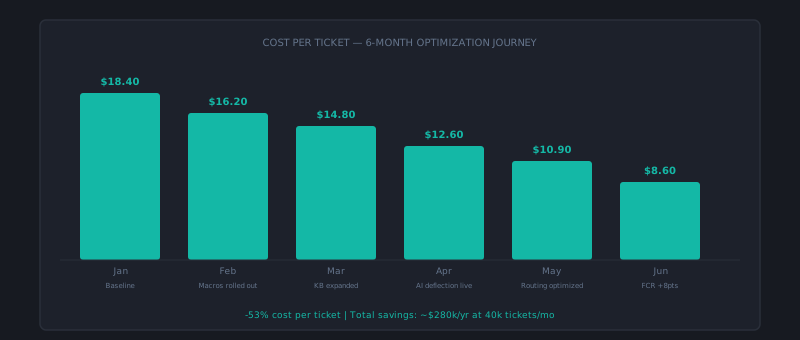
Cost per ticket is one of those metrics that support leaders cite in executive conversations but rarely calculate rigorously. The imprecise version — total support spend divided by total tickets — is simple but misleading. It treats a 5-minute password reset and a 4-hour enterprise escalation as equivalent, which they’re not, and it obscures whether cost increases are driven by volume or by efficiency problems.
A rigorous cost per ticket calculation is more useful — and more actionable.
The correct formula
Total support cost / total resolved tickets = average cost per ticket
But the inputs need to be right:
Total support cost should include:
- Agent compensation (salary + benefits — typically 70-80% of total support cost)
- Management and team lead compensation (prorated for time spent on support activities)
- Tooling and software (helpdesk, QA tools, workforce management, phone/chat platforms)
- Training and onboarding cost (annualized)
- Facilities (if applicable — office space per FTE)
What to exclude: R&D allocated to support tooling, sales/marketing costs for customer success, and anything that isn’t directly attributable to operating the support function.
Total resolved tickets should use resolved tickets, not received tickets. An unresolved or re-opened ticket hasn’t produced a resolution yet. Using received tickets understates cost when backlog is growing.
For a team of 15 agents at $55,000 average fully-loaded cost, plus $120,000 in tooling and management overhead: Total annual cost: $945,000 Resolved tickets per year: 75,000 Cost per ticket: $12.60
This is within range for a mid-market SaaS support org. Industry benchmarks vary widely by complexity and channel mix — $8 to $35 per ticket is the typical range, with technical B2B support at the high end.
Why segmented cost per ticket is more useful
The single-number cost per ticket is useful for trend tracking but not for prioritization. Segmenting by ticket category reveals where your cost is actually coming from.
A sample segmented view:
| Category | Volume | Avg. handle time | Burdened cost/hr | Cost per ticket |
|---|---|---|---|---|
| Password reset | 12,000 | 4 min | $28 | $1.87 |
| Billing inquiry | 18,000 | 18 min | $28 | $8.40 |
| Technical troubleshooting (L1) | 22,000 | 35 min | $28 | $16.33 |
| Technical escalation (L2) | 8,000 | 75 min | $42 | $52.50 |
| Enterprise escalation | 2,000 | 140 min | $55 | $128.33 |
This view changes the prioritization entirely. Reducing password reset cost per ticket by 50% saves $11,220/year. Reducing technical escalation cost per ticket by 20% saves $84,000/year. The escalation category is where efficiency improvements have real impact.
The five levers that move cost per ticket
1. Deflection (reducing numerator tickets, not denominator cost)
Self-service deflection reduces cost by removing tickets that would have required agent handling. A knowledge base that deflects 5,000 tickets per year at $8 average saves $40,000 — and those tickets were likely in your lower-cost categories (the customer found the answer, so it was probably findable). This is the highest-leverage lever at scale.
2. Handle time reduction
Average handle time × burdened hourly cost = per-ticket cost. Anything that reduces handle time without compromising resolution quality reduces cost. Strong macro libraries, better tooling, faster diagnosis data access, and clearer processes all contribute.
Watch for false handle time reduction — closing tickets faster without fully resolving them increases re-open rate and turns one cheap ticket into two.
3. Routing accuracy
A ticket handled by the right agent the first time costs less than a ticket that’s mis-routed, re-assigned, and finally handled by the right agent on the third attempt. Each re-routing adds waiting time and, often, re-reading time. Routing accuracy improvement is a quiet cost lever.
4. FCR improvement
A re-opened ticket is a ticket you pay for twice. Improving FCR from 70% to 80% on your highest-volume category eliminates 10% of the tickets in that category. Calculate the cost impact: 18,000 billing tickets × 10% re-open rate × $8.40 = $15,120 in re-open cost. A 10 percentage point FCR improvement on that category saves roughly $1,500 per point.
5. Tier optimization
Ensuring issues are handled at the appropriate tier reduces cost because Tier 1 costs less per hour than Tier 2, which costs less than Tier 3. Issues that bubble up unnecessarily to higher tiers carry a cost premium. Reducing unnecessary escalation rate by 15% in a high-volume technical category can save significantly.
The cost-quality trade-off
Cost per ticket is not an optimization target in isolation. A support org that drives cost per ticket to $3 by closing tickets immediately and giving incomplete answers has optimized the wrong thing — re-open rates will spike, CSAT will fall, and churn from poor support experience will cost more than the efficiency gains.
The right framing is cost per resolution — where resolution means the customer’s issue was actually addressed and they didn’t need to contact support again. Track cost per ticket alongside re-open rate and CSAT. Cost reduction that maintains or improves quality is genuine progress. Cost reduction that drives quality down is a short-term metric improvement with long-term business damage.
Using the metric in executive conversations
Cost per ticket is a useful metric for executive audiences because it connects support operations to business outcomes in language finance teams understand. A few principles for presenting it:
- Always show the trend, not just the current number. A declining cost per ticket tells a story about improving efficiency.
- Show cost per ticket alongside CSAT trend. Cost going down while CSAT holds or rises is the proof that efficiency gains are real.
- Contextualize against volume changes. If ticket volume doubles and total cost increases 60%, cost per ticket went down — that’s a meaningful efficiency story even if the absolute cost number looks alarming.
Cost per ticket, calculated correctly and tracked consistently, is one of the cleaner ways to demonstrate that support ops improvements are producing business value — not just operational value. That’s a useful conversation to be able to have. AI-first support platforms like AItocha CX reduce cost-per-ticket by deflecting routine volume before it reaches an agent.