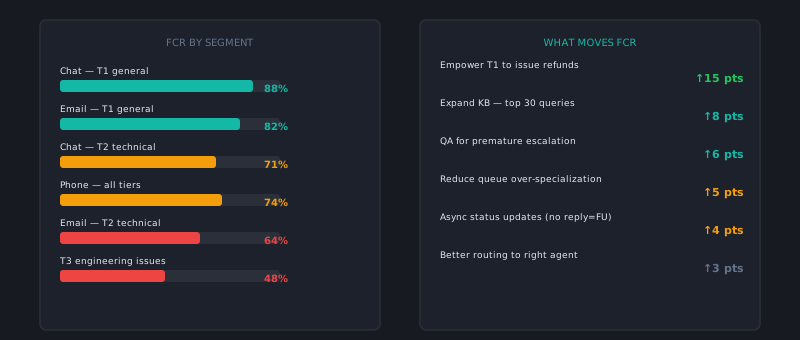
First Contact Resolution rate — the percentage of customer issues resolved without a follow-up contact — is one of the most commonly cited support metrics and one of the most commonly measured incorrectly. Get the definition wrong and the number looks great while the underlying performance is poor. Get it right and it becomes one of the most useful levers you have for improving both customer experience and operational efficiency.
This guide covers how to define, measure, and actually improve FCR in practice.
Why FCR matters beyond the obvious
The obvious reason FCR matters is customer satisfaction. Customers who get their problem solved the first time are significantly more satisfied than those who have to contact support multiple times for the same issue. Research consistently shows a 15–30% satisfaction gap between resolved-first-contact and multi-contact experiences.
The less obvious reason is cost. Every follow-up contact on the same issue is a ticket you’re paying for twice. At scale, reducing multi-contact rates by even 5 percentage points can mean tens of thousands of dollars in avoided agent time per year for a medium-sized support org.
The third reason is what FCR exposes. Low FCR is almost never purely a support quality problem — it’s usually a signal of something else: incomplete information in responses, tooling that prevents agents from seeing full customer context, a product with a recurring bug nobody has escalated properly, or policies that force multiple contacts to complete a single request.
How most teams measure it wrong
The most common FCR measurement approach: count tickets where the customer didn’t reply within 48 hours and call it “resolved.” This is almost always wrong.
Problems with this approach:
It conflates silence with satisfaction. A customer who gave up is not a resolved customer. They’ll churn, or post a review, or call back next week with two problems instead of one.
It doesn’t account for channel switching. If a customer emails, doesn’t get a useful answer, then calls — most ticketing systems won’t link those two contacts. They look like two separate FCR successes when they’re a single FCR failure.
It doesn’t distinguish between agent-closed and customer-confirmed. An agent can mark a ticket resolved before the customer agrees it is. Velocity incentives — average handle time targets, ticket-per-day quotas — push toward premature closes.
A better measurement framework
FCR should be defined as: the percentage of contacts where the customer’s issue was fully addressed and the customer did not need to contact support again for the same or related reason within a defined window.
A practical implementation:
-
Set your measurement window. Seven days is the most common. Contacts about the same issue within 7 days of the original contact count as FCR failures. Anything after 7 days is treated as a new contact.
-
Match contacts by customer, not just ticket ID. Your ticketing system needs to link a customer’s phone call, email, and chat sessions to the same contact record, or you’ll miss channel-switching failures.
-
Use post-resolution surveys, not re-contact rate alone. Ask: “Was your issue fully resolved?” one to two hours after ticket close. Correlate self-reported resolution with actual re-contact data.
-
Segment by ticket type. FCR on a password reset should approach 98%. FCR on a complex billing dispute involving multiple departments might legitimately be 65%. Averaging these together obscures both.
What’s a realistic FCR target?
Industry benchmarks put average FCR across support organizations at around 68–74%. High performers hit 80%+. But these numbers are nearly useless without segmentation.
More useful targets by ticket type:
| Ticket category | Realistic FCR target |
|---|---|
| Password / account access | 90%+ |
| Billing and payment questions | 78–85% |
| How-to and product usage | 75–82% |
| Technical troubleshooting (L1) | 65–75% |
| Complex technical (L2+) | 55–70% |
| Escalated complaints | 50–65% |
Track against these segmented benchmarks and you’ll have a much clearer picture of where the actual gaps are.
The five changes that move FCR most reliably
1. Fix the information completeness problem
The most common reason agents fail to resolve on first contact isn’t attitude or effort — it’s missing information. The agent doesn’t have the customer’s full account history, the right knowledge article, or access to the data needed to diagnose the issue.
Audit your 30 most recent FCR failures. For each one, ask: could the agent have resolved this if they’d had more information? Most of the time, the answer is yes. That identifies the tooling gap.
2. Rewrite your macro library for completeness, not speed
Macros optimized for fast response times tend to be incomplete. They answer the most common version of the question and skip the edge cases. Customers with edge cases reply asking follow-ups.
Review macros that generate more follow-up contacts than average. Rewrite them to address the top 3 follow-up questions upfront. Yes, the macro gets longer — the resolved ticket gets cheaper.
3. Build a “pre-closing” step into your workflow
Before marking a ticket resolved, agents should ask: “Is there anything else I can help clarify?” or equivalently, scan the conversation for any questions the customer raised that weren’t explicitly addressed.
This adds 30–60 seconds per ticket. For tickets with a follow-up rate above 20%, it’s worth it. You can even automate this — set a rule that prompts agents with a checklist before status changes to “solved.”
4. Fix the channel-switching gap
If customers can’t easily escalate from chat to email to phone within a single continuous conversation — or if agents can’t see prior channel history — FCR will suffer structurally. A customer who explains their problem three times to three different agents is not going to feel resolved.
This is an integration problem more than a training problem. Solving it usually means getting your phone, email, and chat systems talking to the same customer record.
5. Track re-open rate alongside FCR
Re-open rate — the percentage of closed tickets that customers re-open or follow up on — is a leading indicator of FCR problems. It’s faster to measure than full 7-day re-contact rate and gives you earlier signal to intervene.
A re-open rate above 15% in any ticket category is worth investigating immediately.
Improving FCR consistently is one of the highest-leverage things a support org can do — for cost, for satisfaction, and for the team culture that comes from agents who feel effective rather than just busy. It starts with measuring it correctly. Most of the improvement comes from fixing information access and communication completeness, not from pushing agents harder.
For teams exploring how AI first-response layers affect FCR, AItocha’s customer experience platform publishes data on how confidence-gated AI resolution interacts with human FCR rates — a useful data point when building your measurement baseline.