Angry customers are one of the most draining parts of support work — and also one of the most mishandled. The instinct in the moment is to either apologize endlessly (which can feel hollow and prolongs the interaction) or to get defensive (which never ends well). Neither approach works. What works is a structured approach that acknowledges the customer’s experience, focuses on resolution, and maintains professionalism without being robotic.
This guide gives agents a concrete framework, not vague advice about empathy.
Why customers get angry
Understanding the root cause of customer anger changes how you respond to it. Most customer anger in support contexts comes from one of three sources:
Unmet expectations. The product didn’t do what the customer thought it would, or the support experience took longer than they thought it should. This anger is about disappointment — the customer had a picture of how things would go, and reality didn’t match.
Accumulated friction. The customer has contacted support before about this. They’ve explained the issue already. They’re not angry about the current interaction — they’re angry about the history. They feel like they haven’t been heard.
Loss and stakes. Something important is broken. The customer is losing money, missing a deadline, or their business is impacted. The anger isn’t about the interaction — it’s about the impact. They’re under real pressure.
Each type calls for a slightly different response. Unmet expectations need clear communication about what will actually happen. Accumulated friction needs explicit acknowledgment that you’ve seen the history. High-stakes situations need urgency and a clear owner.
The LARA framework
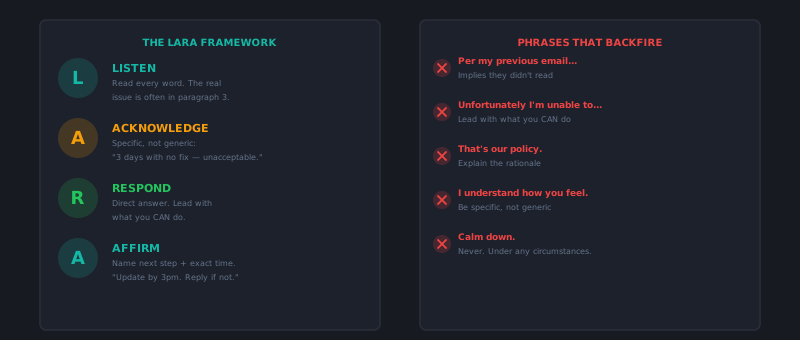
Listen. Acknowledge. Respond. Affirm.
This four-step structure is simple enough to use under pressure and comprehensive enough to handle most situations.
Listen: Read or listen to the customer’s message completely before responding. Don’t start formulating your reply until you’ve taken in everything they said — including the second issue buried in paragraph three. Angry messages are often multi-layered. Responding to the first layer while missing the second will restart the cycle.
Acknowledge: Before explaining anything, acknowledge what the customer experienced. Not what caused it, not whose fault it was — what the customer felt. “That sounds genuinely frustrating, especially with your presentation tomorrow.” Acknowledgment is not agreement or admission. It’s recognition. It’s the fastest way to lower the emotional temperature.
The acknowledgment has to be specific to be effective. “I’m sorry you’re having this experience” is less effective than “I understand you’ve been waiting three days and still don’t have resolution — that’s not acceptable, and I can see why you’re frustrated.” The specific version proves you read what they wrote.
Respond: Now provide the actual answer, action, or next steps. Be direct. Angry customers don’t want hedged language — “it’s possible that…” and “we may be able to…” make things worse. If you know the answer, say it clearly. If you need to investigate, say exactly what you’re doing and when you’ll have an update.
If the customer asked for something you can’t do — a refund you’re not authorized to give, a timeline you can’t commit to — say so directly but explain what you can do. “I’m not able to issue a refund for that charge, but here’s what I can do: credit your account for next month, which covers the same amount.”
Affirm: Close by affirming the path forward and inviting questions. “I’ll have an update for you by 3pm tomorrow. If you don’t hear from me by then, reply to this email and it’ll go straight back to me.” This gives the customer something concrete to hold onto, which is what angry customers usually need more than anything.
What not to say
Some phrases reliably make things worse:
- “Per my previous email…” — Implies the customer failed to read, which is condescending and increases frustration.
- “Unfortunately, I’m unable to…” — Begins with a negative, signals bureaucratic inflexibility. Lead with what you can do.
- “That’s our policy.” — Correct but useless. If you’re enforcing a policy, explain the rationale briefly. “Our refund window is 30 days because…” is a conversation. “That’s our policy” is a wall.
- “I understand how you feel.” — Almost never land as intended. “I understand your frustration” is marginally better. Specific acknowledgment is better than either.
- “Calm down.” — Never. Under any circumstances.
Managing your own state during difficult interactions
Angry customers are emotionally contagious. An agent who absorbs a customer’s anger and starts responding from a defensive or anxious state will produce worse responses and experience faster burnout.
Practical in-the-moment techniques:
Pause before responding. Even a 60-second pause before drafting a reply — to read the message carefully, take a breath, and decide on tone — produces noticeably better responses. The customer is not timing your reply to the minute.
Read the message for information, not emotion. An angry message contains both emotional content (frustration, accusations) and informational content (what happened, what the customer needs). Train yourself to extract the information first, respond to that, and acknowledge the emotion — in that order in your mind, reversed in your response.
Use a physical reset. For phone or chat, some agents find that standing up, taking a slow breath, or stretching briefly before picking up a difficult interaction helps separate the previous interaction’s emotional residue from the new one.
When to escalate
Some interactions need to go to a supervisor not because of technical complexity but because of interpersonal dynamics. Escalate when:
- The customer explicitly requests a supervisor (always honor this)
- The interaction has cycled more than twice without progress
- The customer is using abusive language toward the agent personally (not venting frustration — personal attacks)
Abusive interactions should be documented and can be ended if the behavior is severe. Every support org should have an explicit policy on this and train agents to know they’re supported in ending interactions that cross the line.
Handling difficult customers well is a skill that takes genuine practice — it’s not just attitude or patience. Teams that train on specific frameworks, debrief after difficult interactions, and create a culture where challenging calls are shared rather than hidden individually develop noticeably faster than teams that treat it as a personality trait you either have or don’t. Platforms like AItocha CX give agents full conversation history and sentiment context before they even type a response, which makes the acknowledgment step significantly more specific.