The resumé problem
Support hiring often relies on signals that don’t predict performance: years of experience, help desk software familiarity, previous job titles. None strongly predict whether someone will be effective with frustrated customers under time pressure. Familiarity with modern AI support tooling — platforms like cx.aitocha.com — is worth screening for explicitly, especially for senior agent and lead roles.
The competencies that predict performance
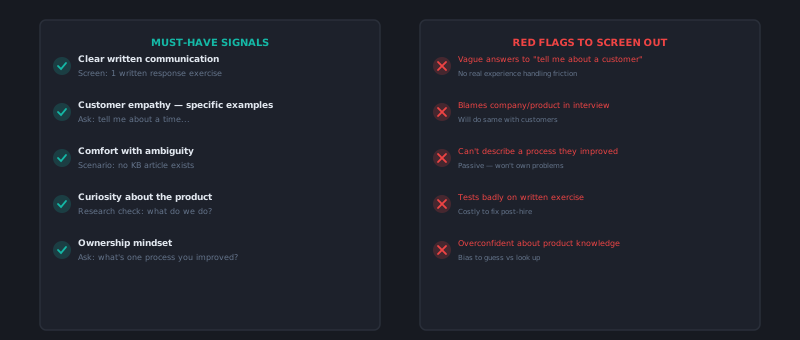
Written communication clarity. Support work at scale is predominantly written. Explaining a complex situation simply, without jargon, in a professional but not cold tone — this is the core skill. Most managers hire this last and should hire it first.
Composure under pressure. Agents regularly receive misdirected frustration. Remaining clear-headed and solution-focused in these moments is a trait. It can be developed, but it’s more efficiently selected for.
Pattern recognition. Good agents identify what type of problem this is from incomplete information, recall the relevant policy, and apply it accurately. This is building and using a mental model, not memorization.
Genuine curiosity about customer problems. Agents who find customer problems interesting perform better and burn out slower than agents who treat each ticket as a disposal task.
The interview process
Writing sample (before the interview): Ask candidates to respond to a sample support ticket — moderately complex, requiring both empathy and accuracy. Score on clarity, tone, and accuracy. This filters faster than a phone screen.
Behavioral interview: Specific past examples, not hypotheticals. “Tell me about a time a customer was angry about something that wasn’t your fault.” Evaluate composure, problem-solving, and how they talk about the customer.
Live scenario: Give a scenario mid-interview: a customer is threatening to cancel because of a billing error that’s partially their fault. Have them draft the response. Observe their process.