Support teams carry more institutional knowledge than most organizations recognize. The experienced agent who knows exactly which error code maps to which obscure configuration issue, which enterprise customer needs careful handling due to contract history, which product areas produce the most edge cases — that knowledge doesn’t exist in any documentation. It lives in people. When those people leave, it walks out with them.
Agent turnover rates in support average 30–45% annually in the industry. For a 15-person team, that’s 4–7 complete knowledge departures per year. The teams that weather this well have systems for capturing and transferring knowledge before people leave, not after.
What knowledge actually needs transferring
Not all agent knowledge has equal value. The most valuable knowledge to capture is the kind that takes the longest to develop and is hardest to reconstruct:
Deep product area expertise: Specific agents often develop deep knowledge of particular product areas through repeated exposure. This includes knowing the common failure modes, the internal architecture context (even without engineering access) that helps diagnose issues, and the workarounds that work even when the documented process fails.
High-value customer context: Experienced agents build up context on key accounts — their contract history, their past issues, their communication preferences, the backstory on why they’re sensitive about certain topics. This context is stored in conversations but rarely in a structured, accessible format.
Escalation network knowledge: Who to contact in engineering for what type of issue, which product manager to loop in for a specific feature complaint, which account manager owns which enterprise customer — this network knowledge is invisible to new hires and rarely documented.
Undocumented resolutions: Solutions to recurring problems that aren’t in the official knowledge base because nobody wrote them down. Experienced agents often have 20–30 of these in their heads.
Building a knowledge capture process before departure
The worst time to capture an experienced agent’s knowledge is the two weeks of their notice period. They’re mentally checked out, focused on transition logistics, and you’re trying to extract what took years to build.
Better approach: treat knowledge capture as an ongoing process, not an exit activity.
Quarterly knowledge interviews: Once per quarter, each team lead conducts a 30-minute structured interview with agents focused on: “What have you learned this quarter that isn’t written down anywhere?” The outputs go into a central knowledge base — internal documentation, updated macros, or a dedicated “solved by experience” section.
Ticket tagging for knowledge value: When an agent resolves an unusual or complex ticket in a non-obvious way, they tag it knowledge-worthy. These tickets are reviewed by the lead and turned into internal documentation if the solution is generalizable. This is faster than interviewing and captures knowledge in the moment.
Customer context capture: For any customer spending above a defined threshold or with a complex account history, create a customer brief: a structured document covering their history, current situation, past issues, and handling preferences. Any agent who picks up a ticket from that customer reads the brief first. Maintain it after every significant interaction.
Structuring the internal knowledge base
An internal knowledge base only works if agents use it. Two common failure modes: too hard to find the right thing, and too time-consuming to contribute.
Structure for findability:
- Organize by product area and then by problem type (not by who documented it or when)
- Every article searchable by the error message or customer-facing symptom, not just the technical description
- Mark articles with confidence level: “Confirmed resolution” vs. “Worked for some cases” vs. “Under investigation”
Structure for contribution:
- Contributions should be 5 minutes of work, not 30 minutes. Use a template that asks for: problem description (2 sentences), steps to resolve (numbered), any exceptions or edge cases, and the agent’s name for follow-up questions
- Accept incomplete contributions. A partial article that captures 60% of the knowledge is infinitely better than a complete article that was never written because the standard was too high
Review contributed articles quarterly — verify they’re still accurate as the product evolves, and flag outdated ones.
The departing agent knowledge transfer
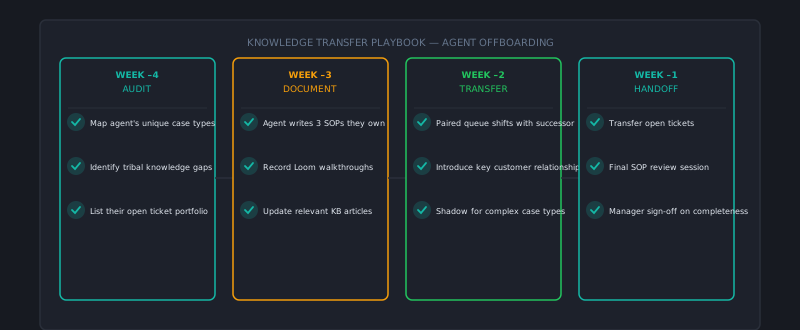
Even with ongoing knowledge capture, a departing agent will have knowledge that hasn’t been captured yet. Structure their last two weeks to extract maximum value:
Week 1 (ideally): Departing agent identifies the 5–10 things they know that they’re most uncertain are documented elsewhere. They write or record these during normal work hours — this is not overtime work, it replaces some of their ticket handling.
Shadowing sessions: Have the departing agent handle complex tickets while a more junior agent or lead shadows them, asking “why did you do it that way?” after each decision. These sessions surface tacit knowledge that wouldn’t come out in a structured interview.
Account handoff briefs: For any key account the departing agent owned or handled primarily, they write a handoff brief: current status, open issues, recent history, upcoming expected contacts.
Exit interview component: The standard HR exit interview focuses on why the agent is leaving. Add a support-specific 30-minute session focused on what they know that they’re worried will be lost. This is explicitly not an HR conversation — it’s a knowledge conversation.
Measuring knowledge transfer effectiveness
The clearest metric: new agent ramp time to full productivity. If a new agent reaches 90% of their target performance metrics in 8 weeks, your knowledge transfer and onboarding process is working. If it takes 20 weeks, knowledge isn’t being transferred effectively.
Leading indicators:
- Internal knowledge base article count and recency (is knowledge being captured regularly?)
- New agent escalation rate in first 90 days vs. veteran agents (high escalation rate = knowledge gaps)
- First-response quality score for new agents (are they finding answers or guessing?)
The investment in knowledge infrastructure pays back every time a new agent gets to full productivity two weeks faster, every escalation that doesn’t happen because an agent found the answer in documentation, and every customer who gets a confident, accurate response from someone who’s been on the team for three months.
The support teams that handle turnover best treat knowledge as an infrastructure problem, not a people problem. The people will always turn over — at some rate, inevitably. What you can control is how much knowledge your systems capture before they leave, and how quickly the systems transfer it to the next person who sits down at that desk. Platforms like AItocha CX surface institutional knowledge inline during active tickets, which reduces the dependency on individual agent expertise.