Quality assurance in support is one of those functions that sounds resource-intensive — you picture dedicated QA analysts, specialized software, and scoring rubrics fifty fields long. In reality, a QA program that meaningfully improves agent output and customer experience can be built with a spreadsheet, 30 minutes of team lead time per week, and a clear framework. Here’s how.
What a support QA program actually needs to accomplish
The purpose of QA is not to evaluate agents — it’s to improve them. This distinction matters because it shapes how QA is designed and communicated. An evaluative QA program creates defensiveness and gaming. An improvement-oriented QA program creates agents who seek feedback and develop faster.
Concretely, a well-run QA program should:
- Surface specific, actionable coaching opportunities for individual agents
- Identify systemic issues (a macro that’s being misused, a policy that’s unclear) before they become CSAT problems
- Create a consistent standard of “good” that agents understand and can achieve
- Provide data to show quality trends over time — improving, declining, or stable
A QA program that only generates scores without driving behavior change is administrative overhead, not a quality program.
Designing the scorecard
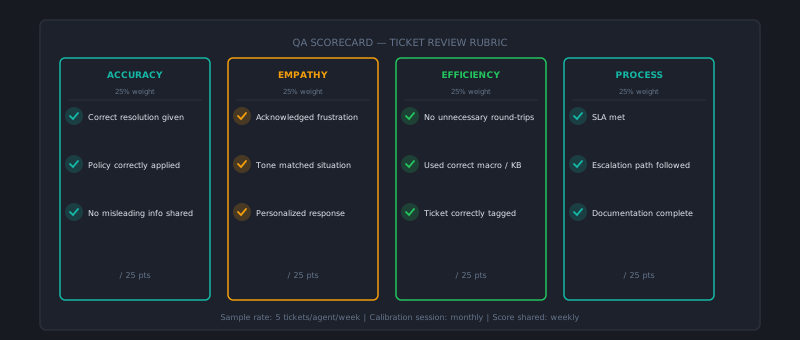
The biggest mistake in QA scorecard design is making it too long. A 40-point rubric covering everything from greeting formality to technical accuracy to emoji usage takes 15 minutes per ticket to score, creates inconsistency between scorers, and produces so much feedback that agents can’t prioritize what to improve.
A practical scorecard has 6–8 criteria, each rated on a 1–3 scale (not 1–10 — the precision is false and the calibration effort is real). Group them into two categories:
Must-haves (binary): Things that every response must do or must never do. Examples:
- Did the agent fully address every question the customer asked?
- Did the agent avoid sharing incorrect information?
- Did the agent follow the applicable policy (refund policy, escalation criteria, etc.)?
If an agent fails any must-have, the ticket is a QA failure regardless of the other scores.
Quality factors (1–3): Things that vary in quality across agents and can be improved with coaching. Examples:
- Clarity and completeness of the explanation (1 = unclear, 3 = perfectly clear with no follow-up needed)
- Tone and empathy (1 = robotic or dismissive, 3 = appropriately warm and professional)
- Efficiency (1 = unnecessary back-and-forth or repetition, 3 = concise path to resolution)
Calibrate the scorecard quarterly — have two leads score the same 5 tickets independently and discuss disagreements. Calibration is what makes the scores mean something.
Sampling: how many tickets to review
The right sample size balances statistical usefulness with the time cost of review. Practical targets:
- Small teams (under 10 agents): 3–5 tickets per agent per week. One hour of review time per lead.
- Mid-size teams (10–25 agents): 2–3 tickets per agent per week. Use rotating review — not every lead reviews every agent every week.
- Larger teams (25+ agents): 1–2 tickets per agent per week, with deeper review triggered by CSAT survey complaints or re-open flags.
Sampling should be semi-random. Pull tickets across channel (email, chat, phone if transcribed), ticket category, and ticket difficulty. Don’t only sample easy tickets — an agent who handles easy tickets well but struggles with complex ones looks artificially good.
For random sampling without specialized software: most helpdesks allow you to filter tickets by agent, date range, and status. Export a list and use a random number generator to select ticket IDs. It takes 5 minutes and requires no tooling beyond what you have.
The feedback conversation
A QA score without a feedback conversation is incomplete. Agents should receive their scores with specific examples and space to respond.
Structure the feedback conversation around three points:
-
What was done well. Start here. Specific example from a reviewed ticket. Not “you’re doing great generally” — “in this ticket, the way you acknowledged the customer’s frustration before explaining the technical issue was exactly right.”
-
One improvement focus. Not five improvement areas — one. The single most important thing to work on over the next two weeks. Specific and behavioral: “In three of your reviewed tickets this week, responses didn’t address all the questions the customer asked. The customer’s second question was answered in the follow-up ticket. Focus on reading through the full customer message before drafting a response.”
-
What you’ll both watch. Agree on one observable behavior to track before the next QA review. This closes the feedback loop: the next review starts with “last time we talked about X — let’s look at how that’s going.”
This conversation should take 20–30 minutes. If it’s shorter, the feedback isn’t specific enough.
Tracking trends without specialized software
A simple Google Sheet or Notion database tracking the following per ticket review is sufficient:
- Date, agent name, ticket ID, ticket category
- Score per criterion (1–3)
- Overall score (must-have pass/fail + quality average)
- One-line coaching note
From this, you can produce a weekly team aggregate view (average quality score by criterion — which criteria are improving, which are declining?) and an agent view (each agent’s trend over 4–8 weeks).
When average scores on a specific criterion decline across multiple agents simultaneously, that’s almost never a training problem — it’s a policy change, a macro update, or a workflow change that introduced confusion. Investigate at the systemic level before coaching individuals.
When to escalate from coaching to HR
QA programs occasionally surface performance issues that go beyond coaching scope. The threshold varies by organization, but a practical guide: if an agent scores below minimum threshold on must-have criteria in more than 25% of reviewed tickets over three consecutive review periods — and the feedback conversations have been specific and documented — it’s a performance management conversation, not a QA conversation.
Document QA scores and feedback conversations in a way that’s accessible to HR. QA data is often the most objective record of performance patterns available, and it’s valuable context for formal performance processes.
The goal of a good QA program is to make it unnecessary to micromanage. When agents understand what “good” looks like, receive regular specific feedback, and see their own improvement over time, quality self-reinforces. The QA program is the feedback mechanism — not the quality itself. AItocha CX automates QA scoring across 100% of ticket volume — making a robust QA program feasible without a dedicated QA headcount.