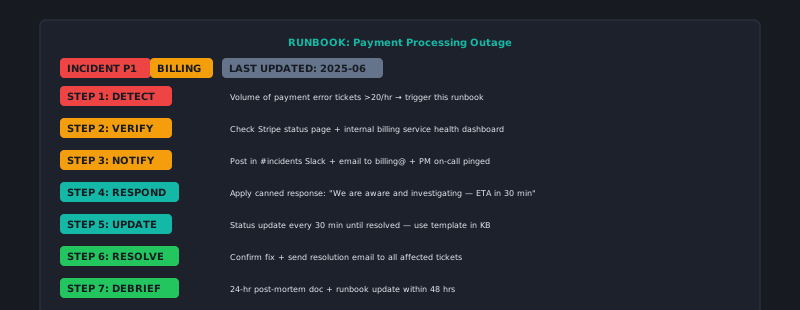
A runbook is a step-by-step guide for a specific, recurring scenario — not a general policy document, not a training manual, but a concrete procedure that an agent can follow in the moment to handle a specific situation correctly. Good runbooks are one of the most underused tools in support operations. They reduce variability in how agents handle complex scenarios, enable less experienced agents to handle situations they haven’t encountered before, and create institutional consistency that doesn’t depend on any individual agent’s presence.
Here’s how to build them well.
What deserves a runbook
Not every situation needs a runbook. Runbooks are most valuable for:
High-stakes, low-frequency scenarios: A product outage, a data loss report, a security incident. These situations are rare enough that agents don’t develop automatic responses through repetition, but consequential enough that handling them wrong has serious customer and business impact. A runbook ensures the right steps happen in the right order even when nobody on shift has seen this before.
Multi-step processes with decision branches: Refund processing that depends on purchase date, payment method, and customer tier. Account recovery workflows with identity verification requirements. Anything where the correct path depends on multiple conditions that agents might evaluate inconsistently without guidance.
Cross-functional handoffs: Processes that involve transferring a ticket or initiating an action with another team — engineering escalations, legal review requests, compliance notifications. Runbooks ensure the handoff includes the right information and follows the right path every time.
High-volume scenarios with complex edge cases: Password reset processes seem simple but generate edge cases — SSO accounts, MFA issues, compromised accounts — that need specific handling. A runbook that covers the main path and the common edge cases prevents 20 slightly different improvised approaches.
The runbook structure
A runbook should be scannable in under 60 seconds and followable step-by-step under pressure. This is not the place for narrative explanations. The format is:
Title: Specific enough to find when searching. “Handling suspected account compromise” not “Security runbook.”
When to use this: A brief triggering condition. “Use this runbook when a customer reports unauthorized access to their account, unexpected password changes, or suspicious login activity they didn’t initiate.”
Prerequisites: What the agent needs before starting. Access levels, tools open, information gathered from the customer.
Steps: Numbered, sequential, imperative. Each step is one action. No paragraphs. If a step has a condition (“if X then Y, else Z”), format it explicitly as a branch, not buried in a step description.
Expected outcomes: What the agent and/or customer should see if the runbook executed correctly.
Escalation point: When and to whom to escalate if the runbook doesn’t resolve the situation.
Do not do: Explicit prohibitions for the most consequential wrong actions. A security runbook might include: “Do not reset account password without identity verification. Do not communicate compromised account details via email. Do not close the ticket before confirmation from the security team.”
A template
# Runbook: [Title]

## When to use
[1–2 sentences describing the triggering condition]

## Before you start
- [ ] You have [access/tool/information]
- [ ] You have [second prerequisite]

## Steps

1. [Action]. Expected result: [what you should see]

2. [Action]
   - If [condition A]: go to step 3a
   - If [condition B]: go to step 3b

3a. [Action for condition A]
3b. [Action for condition B]

4. [Continue...]

## Verify success
[What confirms the runbook completed successfully]

## If this doesn't work
Escalate to [team/person] via [mechanism]. Include [required information].

## Do not
- [Prohibited action 1]
- [Prohibited action 2]

---
Last updated: [date] | Owner: [name]
Writing the steps
The common writing mistake is combining explanation with instruction. Agents following a runbook under pressure need instructions, not context. Context goes in the training documentation — the runbook is the job aid.
❌ “Because our billing system has a 24-hour processing window, you’ll want to first check the transaction date and compare it to today’s date, because if it’s within that window the customer may see…”
✅ “Check the transaction date. If it is within 24 hours of today’s date: [go to step 4]. If it is older than 24 hours: [go to step 5].”
The second version takes 3 seconds to follow. The first takes 30 seconds to read and then requires the agent to extract the instruction from the explanation.
If you find yourself writing long explanatory prose in a runbook step, that content belongs in a knowledge base article that the runbook can link to. The runbook says “do X”; the knowledge base article explains why.
Keeping runbooks current
Runbooks go stale. A runbook written for a product that has since been redesigned will send agents down paths that no longer exist. A runbook for a billing process that changed when you switched payment processors will produce incorrect outputs.
Maintenance practices:
- Tag runbooks with version dates and owners. The owner is responsible for reviewing the runbook when the relevant product area or process changes.
- Link runbooks from the relevant help center articles where they’re mentioned. When the help center article is reviewed, the linked runbook gets reviewed.
- Add a “this step doesn’t work” flag to runbook interfaces. When an agent encounters a step that doesn’t match current reality, they can flag it immediately. The flag triggers a review.
- Runbook review as part of post-incident process. After any incident or high-stakes scenario where a runbook was used, include a runbook review step: did the runbook help? Did any step fail to account for current reality? Update as needed.
A library of five accurate, well-maintained runbooks is more valuable than fifty that haven’t been reviewed since they were written. Focus on building the maintenance habit before expanding the volume.
Runbooks are what allow a support team to be larger than the sum of its institutional knowledge. When the right runbook exists and agents know how to find and follow it, the team’s collective capability to handle complex situations extends beyond what any individual has personally experienced — and that’s a meaningful operational advantage. Platforms like AItocha CX can surface relevant runbooks inline during active incidents, closing the gap between documented process and agent action.