The library that goes stale
Almost every support team has a collection of SOPs, playbooks, and process documents. Almost every support team also has SOPs that are months or years out of date, organized in a structure nobody can navigate, and consulted only when someone can’t find a colleague to ask.
The stale library is almost always the result of two failures: documents were created but not assigned a maintenance owner, and the library structure was organized for the person who built it, not for the person searching it.
Creating maintainable SOPs
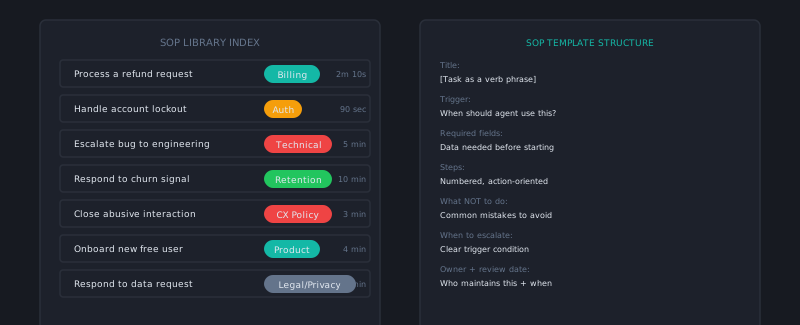
Each SOP has six required fields:
- What this covers — one sentence, written as a task the agent is trying to complete
- When to use this — the specific trigger
- Steps — numbered, with no step requiring more than one decision
- Common mistakes — the two or three errors agents most often make
- Escalation trigger — the specific condition that requires escalation
- Owner and review date — the person responsible for keeping this current
The owner field is what separates a maintained SOP from one that goes stale. Every SOP has a named owner whose job it is to update it when the process changes.
Organizing for search, not browsing
Agents searching for an SOP know what they’re trying to do, not where the document lives. Name every SOP as a task: “Process a refund request,” “Handle an account access lockout,” “Respond to a shipping delay complaint.” Not “Refund Policy” or “Account Access SOPs.”
Index by customer phrase (what the customer says), task phrase (what the agent does), and product area. Test the library quarterly by giving three new agents the five most common situations and measuring how long it takes them to find the right SOP.
Keeping it current without a documentation project
Assign SOP reviews as a trigger, not a schedule. When a process changes, updating the SOP is part of completing the change. When an agent reports that an SOP was wrong or incomplete, the owner updates it within 5 business days. Quarterly, review the library for any SOPs that haven’t been touched in 6 months and verify they’re still accurate. Platforms like AItocha CX can surface relevant SOPs inline during active tickets, reducing the gap between documented process and agent behavior.