The burnout math nobody talks about
Replacing a support agent costs 50–200% of their annual salary when you factor in recruiting, lost productivity, and training. A team with 25% annual attrition — common in support — is replacing one in four people every year, most of whom left because of burnout that was visible for months before they quit.
Burnout prevention isn’t a wellness initiative. It’s cost containment with better optics.
The three structural causes
Support burnout comes from three sources, and most interventions target the wrong one.
Volume without relief. Queue sizes that grow faster than the team can handle create a chronic state of never caught up. Agents start their shift behind and end it further behind. Over weeks this becomes the normal state, and the normal state is demoralizing.
Emotional labor without recovery. Support agents handle frustrated, upset, and sometimes abusive customers all day. Without structured recovery time between difficult interactions, the emotional weight accumulates.
Lack of agency. Agents who can’t solve problems — who have to escalate everything, who lack the authority to make decisions that would genuinely help customers — feel like obstacles rather than helpers. That role dissonance is corrosive.
Structural fixes by cause
For volume: Implement a queue health metric alongside standard SLA metrics. Queue health tracks the ratio of incoming tickets to resolved tickets over a rolling 7-day period. When queue health falls below 1.0, it triggers an active response: temporary support from adjacent teams, reduced meeting load, or surge staffing. This turns volume problems into a system alert rather than an individual burden.
For emotional labor: Build mandatory buffer time into agent schedules — 15 minutes per 4-hour block with no queue assignment. Teams that implement structured buffer time report significantly lower end-of-day exhaustion than teams where agents go ticket to ticket continuously.
For agency: Audit your escalation policy. If agents are escalating more than 15% of tickets because policy requires it rather than knowledge gaps, the policy is the problem. Expand agent authority to resolve common issue categories without escalation. Agents who can actually solve problems burn out at lower rates.
The leading indicator to track
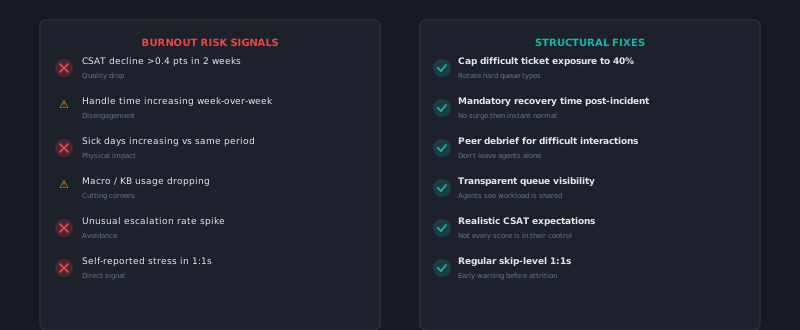
Burnout shows up in the data before it shows up in resignations. Track agent-level metrics monthly:
- Tickets per hour trending down over 4+ weeks
- CSAT scores declining for a specific agent after a previously stable period
- Unplanned absences increasing
- Escalation rate increasing without a corresponding volume spike
Any of these patterns on an individual agent is a signal worth a conversation. Waiting for the resignation letter is waiting too long. Routing intelligence in platforms like AItocha CX helps distribute ticket load more evenly across agents, reducing the concentration of difficult interactions on your strongest reps.