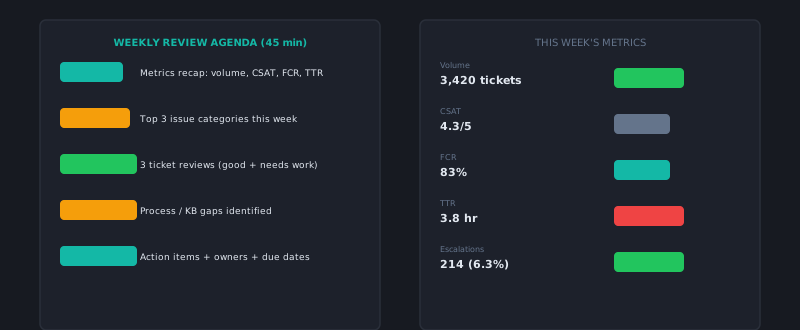
The weekly team meeting is the most recurring operational ritual in a support org, which means it’s also the one most likely to calcify into something that wastes 45 minutes without producing much. A useful weekly review is specific, forward-looking, and produces decisions or actions — not just a recap of metrics everyone could have read in a dashboard.
Here’s a format that works for teams of 5–30 agents, along with the common failure modes to avoid.
The purpose of a weekly review
Before the format, be clear on what the meeting is for:
- Shared operational awareness: Everyone understands how the team is performing, where the pressure points are, and what’s coming this week
- Coordinated response to patterns: When the same issue is appearing across tickets, the team can discuss a consistent approach — rather than 12 agents individually figuring it out
- Agent development touchpoint: A place where agents feel seen, get recognition, and have space to raise questions about complex tickets
- Cross-functional signal transmission: Information that needs to flow to product, engineering, or customer success gets named and assigned
It is not a comprehensive performance review. It’s not an accountability mechanism for individual metrics (those belong in 1:1s, not team meetings). It’s an operational coordination and development forum.
A 45-minute format that works
Opening metrics check (10 min):
Don’t spend time reading metrics aloud that agents already have access to. Instead, pick 3–5 numbers that need interpretation:
- “Ticket volume was up 18% this week — we know this is from the release. Here’s what we’re seeing on the types of tickets coming in.”
- “SLA compliance on P2 dropped from 91% to 84%. Three tickets breached on Tuesday afternoon. Here’s what happened.”
- “FCR is trending in the right direction — third week of improvement.”
The format is: number → what explains it → what we’re doing about it (or why we’re not worried). Numbers without interpretation waste time.
Pattern and case discussion (15 min):
This is the most valuable part. Bring 2–3 specific ticket examples from the past week that illustrate:
- A new type of issue that agents are seeing for the first time and may not know how to handle
- A case that was handled particularly well — specific recognition for the agent, and a discussion of what made it effective
- A case where something went wrong, without blame, focused on what the team would do differently
Agents benefit enormously from seeing real examples with discussion. Abstract coaching (“be more thorough”) is far less effective than “here’s a ticket where the agent missed the customer’s second question — let’s look at it together.”
Product and tooling updates (5 min):
What does the team need to know about the product or their tooling for the coming week?
- Any product changes that will generate new ticket types
- Any tooling updates agents need to be aware of
- Any macro or knowledge base updates that went live
Voice of the customer (5 min):
What patterns is support seeing that product, engineering, or customer success should know about? This is the outbound communication function of the weekly review — support-as-a-function-of-insight rather than just a service function.
Three or four observations max, kept brief: “We’re seeing 15+ tickets this week about [specific feature] — specifically about [specific behavior]. Worth flagging to the product team.” Assign a follow-up owner if action is needed.
Q&A and open items (10 min):
Space for agents to raise anything: confusing policy questions, edge cases they’re not sure how to handle, tooling problems, concerns. This is deliberately open-ended — a team that feels they have no voice in the weekly review will stop engaging with it over time.
The pre-meeting prep that makes it work
The format above requires 20–30 minutes of preparation from the team lead before the meeting:
- Pull the 3–5 metrics that need interpretation (not just a screenshot of the dashboard)
- Select the 2–3 case examples and add context for discussion
- Collect product/tooling updates from your information sources
- Identify the top 1–2 VoC observations worth sharing cross-functionally
Without preparation, the meeting defaults to reading a dashboard aloud and asking if anyone has questions. Preparation is what makes the content discussion-worthy rather than informational.
Common failure modes
Too much data, not enough interpretation. A slide deck of 20 metrics is not a meeting — it’s a report. Keep to 5 metrics maximum and explain each one.
Feedback in public. Individual performance feedback — even positive feedback — is more powerful in private. The team meeting is for patterns and examples, not scorecards. “Alex handled a great escalation this week — let me share what she did” is fine. “Alex’s FCR is the highest on the team” is performance data that belongs in a 1:1.
Not closing the loop. If something was raised at last week’s review and promised follow-up, that follow-up needs to be reported on this week, even if the answer is “still working on it.” Teams that see raised items disappear into a void stop raising items.
Letting it become a stand-up. A weekly review that turns into “anyone have updates?” produces low-value updates. The structure matters. The lead is responsible for keeping the meeting on the agenda.
The weekly review is the weekly rhythm that connects the team’s daily work to the larger picture: what’s working, what needs adjusting, what the company is seeing that affects how they’ll work this week. Teams with a consistent, well-run weekly review have noticeably better coordination and agent development than teams that treat it as an optional check-in. cx.aitocha.com exports the week-over-week metrics — volume, TTR, CSAT, FCR — that make this review meeting substantive rather than anecdotal.