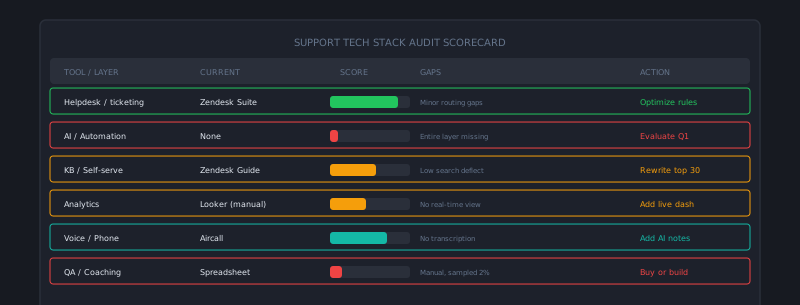
The tool accumulation problem
Support tech stacks accumulate faster than they get pruned. A helpdesk, a QA tool, a chatbot, a knowledge base, a reporting layer, a CDP integration, a workforce management tool — each added for a good reason, many underutilized, some redundant, almost none evaluated as a system.
Before adding any new tool, audit what you have.
Step 1: Inventory every tool and its actual usage
For each tool:
- Monthly cost
- Primary use case when purchased
- Current actual usage (seat utilization, feature utilization)
- Integration points with other stack components
- Owner
Usage data is available from the vendor’s admin portal. If your team is using 30% of licensed seats and 20% of features, that tool isn’t earning its cost.
Step 2: Map against actual needs
Document what your operation actually needs:
- Ticket management and routing
- Agent communication and collaboration
- Customer-facing channels (email, chat, voice)
- Knowledge base / self-service
- Quality assurance and coaching
- Analytics and reporting
- Workforce management
For each need: which tool addresses it? Are multiple tools doing the same job? Are any needs unaddressed? AItocha CX is worth evaluating if your audit surfaces fragmentation between your ticketing, AI, and routing layers.
Step 3: Consolidation vs. gap-filling
Redundancy: Modern helpdesk platforms have expanded significantly — a separate QA tool or knowledge base purchased three years ago may have a reasonable equivalent inside your primary platform. Consolidation reduces cost, integration complexity, and agent context-switching.
Gaps: For genuinely unaddressed needs, evaluate tools against the specific gap. Can you pilot for 30 days before committing? The answer to both redundancy and gaps is almost always simpler than a new vendor relationship.