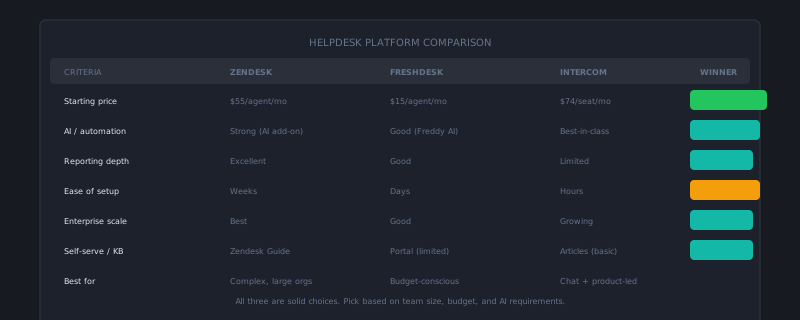
The three platforms dominating mid-market support tool decisions are Zendesk, Freshdesk, and Intercom. Every support lead ends up evaluating them at some point. Every sales team at those companies will tell you theirs is the best. None of them are wrong — and none of them are right for every team.
This comparison is for teams in the 5–50 agent range, handling B2B or B2C SaaS support, and trying to make a durable platform decision rather than just shopping for the lowest price.
The fundamental difference in philosophy
Before comparing features, understand what each platform was designed for:
- Zendesk was built around the ticket. It’s a structured, process-oriented system designed for ops-heavy teams that run support as a function with SLAs, queues, and reports.
- Freshdesk is Zendesk’s value competitor — similar philosophy, similar feature set, significantly lower price, with a few modern additions around AI and omnichannel built into base tiers.
- Intercom was built around the conversation. It thinks about support as continuous, relationship-based communication rather than discrete ticket resolution. Its strongest feature is in-product messaging and proactive support.
This distinction matters more than any individual feature comparison, because it reflects what your team will spend time doing every day.
Zendesk
Where it wins
Zendesk’s reporting and analytics are genuinely excellent. If you need to build custom dashboards, track SLA compliance by ticket type, or produce executive-level ops reports, Zendesk Explore gives you more flexibility than either competitor. Its workflow automation (Triggers, Automations, Macros) is deeply configurable once you learn the system.
The ecosystem is also a real advantage. Zendesk has hundreds of marketplace integrations, and because it’s been around since 2007, most third-party tools — Salesforce, Jira, Slack, PagerDuty — have first-class Zendesk integrations.
Where it falls short
Zendesk’s pricing is aggressive at the top end, and many features that feel like they should be standard (AI features, advanced workflows, CSAT analytics) are gated to expensive plans. The UI has improved but still feels more complex than it needs to be for straightforward use cases. Onboarding a new agent takes longer than on competing platforms.
The AI capabilities in Zendesk (branded as Zendesk AI) are add-ons priced separately, which means the total cost of a competitive setup can exceed what it initially looks like in the base plan pricing.
Best for
Larger support orgs (20+ agents), teams with dedicated ops resources, enterprises with complex SLA requirements, or teams that need sophisticated reporting to serve multiple stakeholders.
Freshdesk
Where it wins
Freshdesk’s free tier is legitimately useful, not just a lead magnet. Up to 10 agents can run a functional operation at no cost. The paid tiers are significantly cheaper than Zendesk for comparable features, which matters a lot at 5–15 agents when budget is limited.
Freshdesk has invested meaningfully in AI tooling — their Freddy AI suite covers classification, auto-suggestion, and a customer-facing bot — and this capability is included in mid-tier plans rather than gated behind enterprise pricing. The multichannel setup (email, chat, phone, social) is relatively straightforward to configure.
Where it falls short
Freshdesk’s reporting is weaker than Zendesk’s. If you need custom analytics beyond the standard dashboards, you’ll hit walls. The integration ecosystem is smaller and some integrations are less robust than their Zendesk equivalents.
The product has a reputation for gradual feature neglect in older parts of the UI. Some workflows that are well-supported in the core ticketing system are awkward in omnichannel configurations.
Best for
Teams of 2–20 agents, cost-sensitive organizations, teams that want AI features without enterprise pricing, and companies that prioritize email-first support over complex channel orchestration.
Intercom
Where it wins
If you’re building a product-led growth motion and support is part of your activation funnel — not just a post-sale function — Intercom is in a different category. Its in-product messaging, onboarding flows, and behavioral triggers are far more sophisticated than what Zendesk or Freshdesk offer.
Intercom Fin, their AI agent, is one of the more capable AI support products available. It can resolve a meaningful percentage of inbound queries using your knowledge base, with a handoff experience that feels intentional rather than jarring.
For support teams that also own customer success or want to blur the line between proactive engagement and reactive support, Intercom’s architecture makes that easier.
Where it falls short
Intercom is expensive — often the most expensive of the three for equivalent team sizes, and pricing is usage-based in ways that can surprise you at scale (per-seat plus per-resolution fees). The ticket management experience is less structured than Zendesk, which can frustrate teams that care deeply about queue discipline and SLA tracking.
Traditional helpdesk features — complex routing rules, detailed SLA policy management, multi-level escalation workflows — are an afterthought compared to the messaging-first core.
Best for
Product-led SaaS companies, teams where support overlaps significantly with customer success or onboarding, and organizations that prioritize proactive outreach and in-product communication.
The decision matrix
| Need | Best fit |
|---|---|
| Complex SLA management | Zendesk |
| Tight budget, 2–15 agents | Freshdesk |
| In-product messaging + proactive support | Intercom |
| Advanced reporting and custom dashboards | Zendesk |
| AI features without enterprise pricing | Freshdesk |
| Product-led growth motion | Intercom |
| Large integration ecosystem | Zendesk |
| Fastest onboarding for new agents | Freshdesk |
What nobody tells you about switching
Switching helpdesk platforms is painful. Ticket history migration is messy, reporting continuity breaks, and your team needs retraining. The cost isn’t just the new license — it’s 2–3 months of ops disruption.
That means the most important question is not “which is best today” but “which will still be the right tool in 3 years as we grow.” A team that expects to triple in size should weight Zendesk’s scalability more heavily. A team that’s going to stay lean should weight Freshdesk’s economics.
Whichever platform you choose, the underlying question is the same: does this tool make it easier for your team to get every customer to a resolution, fast, with enough context to feel like the customer was remembered? Get that right and the platform decision becomes secondary.
One dimension this comparison doesn’t cover: what happens when AI handles the first layer of resolution before a ticket even enters any of these platforms. That’s increasingly how high-volume teams operate — using something like AItocha CX for AI resolution and routing, with Zendesk or Freshdesk as the agent workspace for what’s left. Worth factoring into your architecture decision.